

ThermoWood vs Thermally Modified Wood: Key Differences & Why It Matters
A science-informed, practical guide for architects, builders, and homeowners
When researching eco-friendly wood options for modern projects, you’ll likely encounter two terms: ThermoWood® and thermally modified wood (TMW). At first glance they seem the same, but there are important differences that affect performance, certification, and long-term value. This article explains those differences, with a clear comparison table, real-world applications, and practical buying tips.
ThermoWood vs Thermally modified wood: definitions
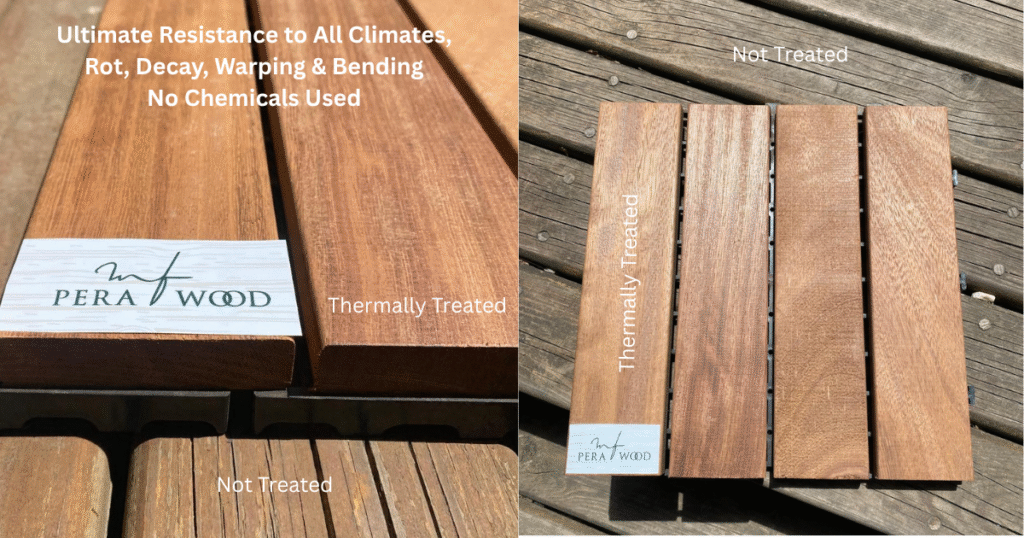
Thermally modified wood—also known as heat-treated or thermal wood—refers to any wood treated with high heat (typically 200 °C / 392 °F) in a controlled environment. This natural process changes the wood’s cellular structure, making it more stable, more durable, and more resistant to moisture and decay.
ThermoWood vs thermally modified wood: standards & certification
ThermoWood® is not generic—it’s a registered trademark managed by the International ThermoWood Association (ITWA). Think “facial tissue” vs “Kleenex”: ThermoWood® is a certified brand of thermally modified timber that follows strict standards.
Certification supports compliance with established European methods (e.g., durability/coating guidance in EN series), backed by audits, testing, and inspections. Generic thermally modified wood can perform similarly, but standards and QA vary by producer.
Why Thermally Modified Wood Matters
- Superior stability — modification enhances the entire board, not just the surface.
- Exceptional dimensional stability — reduced warping, twisting, and shrinking over time.
- Lower equilibrium moisture content
- Improved decay resistance
- Reduced thermal conductivity
- Lighter weight — ~15% lighter than untreated wood, easier to install while maintaining strength.
- Eco-friendly — only heat and steam are used, no harmful chemicals.
- Cost efficiency — higher upfront investment but reduced maintenance and longer service life.
ThermoWood vs thermally modified wood in real projects
Practical Applications
- Decking — durable, weather-resistant, and stable
- Cladding & siding — prevents gaps and warping
- Outdoor furniture — non-toxic, long-lasting
- Sauna interiors — heat and moisture resistance
- Windows & doors — minimal expansion/contraction
- Garden structures — natural decay resistance
Scientific Effects of Thermal Modification
| Property | Untreated Wood | Thermally Modified Wood | Notes |
|---|---|---|---|
| Equilibrium Moisture Content (EMC) | ~8–12% (ambient) | ~4–7% | Lower EMC → higher dimensional stability |
| Density | Baseline | Slight decrease | Mass loss due to heat-driven extractive changes |
| Decay Resistance | Species-dependent | Improved | Cell wall chemistry altered; less nutritive |
| Thermal Conductivity | Baseline | Reduced | Contributes to comfort (sauna/interior) |
| Bending Strength | Baseline | Slight to moderate decrease | Design/specification should consider profile & span |
Comparison Table: ThermoWood vs thermally modified wood
| Aspect | ThermoWood® (Certified) | Thermally Modified Wood (General) |
|---|---|---|
| Definition | Trademarked, standardized process; ITWA oversight | Generic term for heat-treated wood |
| Standards | EN guidance; audited production & testing | Varies by producer; no single global standard |
| Quality Assurance | Documented, consistent, traceable | Producer-dependent, variable |
| Market Recognition | Widely trusted by architects/specifiers | Requires due diligence before specifying |
Process Ranges & Use Guidance
| Topic | Typical Range / Guidance | Practical Implication |
|---|---|---|
| Process Temperature | ~185–215 °C (365–420 °F) | Higher temps → higher stability, possible strength trade-offs |
| Moisture / Steam | Controlled steam environment | Protects against cracking; more uniform treatment |
| Finishing | Oil or exterior coatings (per EN 927 guidance) | UV exposure darkens wood; finish extends aesthetics |
| Fasteners | Stainless steel recommended | Prevents staining/corrosion in exterior use |
| Ventilation/Detailing | Rear ventilation & drainage gaps | Promotes longevity in cladding & decking |
Application Matrix: Selecting Grades & Details
| Application | Recommended | Notes |
|---|---|---|
| Decking | Stable species; ribbed/anti-slip profiles optional | End-seal; allow spacing; consider oil finish for color retention |
| Cladding/Siding | Vertical rainscreen; ventilated cavity | UV finish or natural greying; stainless fixings |
| Sauna | Smooth profiles; low thermal conductivity | Comfortable touch; low resin bleed |
| Windows/Doors | Dimensionally stable sections | Profile design to account for strength changes |
For a deeper primer, see our guide: What is Thermally Modified Wood? (Complete Guide). For certification information, visit International ThermoWood Association.

The Bottom Line
Both ThermoWood® and generic thermally modified wood offer durability, stability, and eco benefits. ThermoWood® guarantees certification and consistency, while other thermally modified products may provide similar performance at a different price point. Your choice depends on budget, project type, and required quality assurance.
Ready to Specify?
Looking for premium thermally modified wood for your next project? Contact PeraWood to request samples or get a tailored quote.
FAQ
Is ThermoWood real wood?
Yes. ThermoWood® is real wood that has undergone a certified thermal modification process overseen by the ITWA.
How long does ThermoWood last outdoors?
Depending on species, detailing, and maintenance, ThermoWood® can last decades with predictable performance.
Is thermally modified wood eco-friendly?
Yes. It uses heat and steam instead of chemicals, reducing environmental impact.
What’s the difference between ThermoWood and thermally modified wood?
All ThermoWood is thermally modified wood, but not all thermally modified wood is ThermoWood®. ThermoWood® ensures certified quality.